
Working at height remains one of the most critical safety challenges across construction, maintenance, and industrial sectors. Mobile Elevated Work Platforms (MEWPs), including boom lifts, are widely used to provide access to elevated work areas that are difficult or unsafe to reach using ladders or scaffolding. However, improper operation of boom lifts continues to be a major cause of serious workplace incidents.
As worksites become more complex and safety regulations more stringent, proper boom lift operator training has become essential rather than optional. Without adequate training, even well-maintained lifting equipment can pose significant risks to operators, nearby workers, and site operations.
In Singapore, boom lifts are commonly used across construction sites, factories, warehouses, shipyards, and facilities maintenance projects. Understanding when boom lift training is required—and what it involves—is crucial for both employers and workers responsible for operating MEWPs safely.
What Is a Boom Lift?
A boom lift is a type of Mobile Elevated Work Platform (MEWP) designed to lift workers to elevated or hard-to-reach areas using an extendable arm. Unlike scissor lifts, boom lifts allow both vertical and horizontal outreach, making them suitable for complex access tasks.
Boom lifts are typically used for:
- High-level construction and façade work
- Industrial plant maintenance and inspections
- Electrical, mechanical, and installation works
- Shipyard and infrastructure projects
- Warehouse and facilities maintenance
Due to their extended reach and mobility, boom lifts introduce unique operational risks. These include tip-over hazards, entrapment, collision with structures, and falls from height—making proper training essential before operation.
What Is Boom Lift Operator Training?
Boom lift operator training is a structured safety and competency programme designed to ensure operators can safely use MEWPs in real-world working environments. The training goes beyond basic machine controls and focuses on hazard awareness, safe operation, and regulatory compliance.
Participants in a Boom Lift Operator Training Course typically learn how to:
- Understand different types of boom lifts and their limitations
- Conduct pre-operation inspections and safety checks
- Operate boom lifts safely under varying site conditions
- Identify hazards associated with height, terrain, and overhead obstacles
- Respond appropriately to emergencies and equipment malfunctions
Certified training ensures that operators are not only familiar with the equipment, but also capable of making sound safety decisions during dynamic work situations.
Key Skills Gained from Boom Lift Operator Training
1. Hazard Identification and Risk Assessment
Operators are trained to assess ground conditions, overhead obstructions, weather exposure, and surrounding site activities before using a boom lift.
2. Safe Operation and Control Techniques
Training covers correct positioning, smooth manoeuvring, load limits, and maintaining stability during elevation and outreach.
3. Pre-Use Inspection and Equipment Checks
Participants learn how to inspect controls, safety devices, hydraulics, and structural components to identify faults before operation.
4. Fall Protection and Emergency Procedures
Operators are trained in the use of harness systems, emergency lowering controls, and rescue procedures in case of equipment failure.
5. Regulatory and Permit Compliance
Boom lift training aligns closely with Singapore’s workplace safety requirements, including permit-to-work systems and site supervision protocols. These competencies support MEWP Safety Certification and help employers meet their duty of care obligations.
When Is Boom Lift Training Required?
Boom lift training is required whenever a worker is assigned to operate a MEWP as part of their job scope. In Singapore, employers are responsible for ensuring that workers are adequately trained and competent before allowing them to operate lifting equipment.
Training is especially critical when:
- Operators are new or inexperienced
- Work is conducted at significant heights
- Sites are congested or structurally complex
- Boom lifts are used near live traffic, machinery, or power lines
- Work conditions change frequently
Failing to provide proper training can expose organisations to serious safety, legal, and operational risks.
Why Certified Boom Lift Training Is Essential
Certified boom lift training plays a vital role in improving workplace safety and operational efficiency. It helps to:
- Reduce accidents, tip-overs, and fall-related incidents
- Improve operator confidence and situational awareness
- Support compliance with MOM and workplace safety standards
- Enhance overall site safety culture
- Protect employers from regulatory penalties and liability
Authoritative guidance from organisations such as the Singapore Ministry of Manpower (MOM) and the Workplace Safety and Health Council (WSHC) emphasises the importance of proper training for work-at-height equipment.
Choosing the Right Boom Lift Training Programme
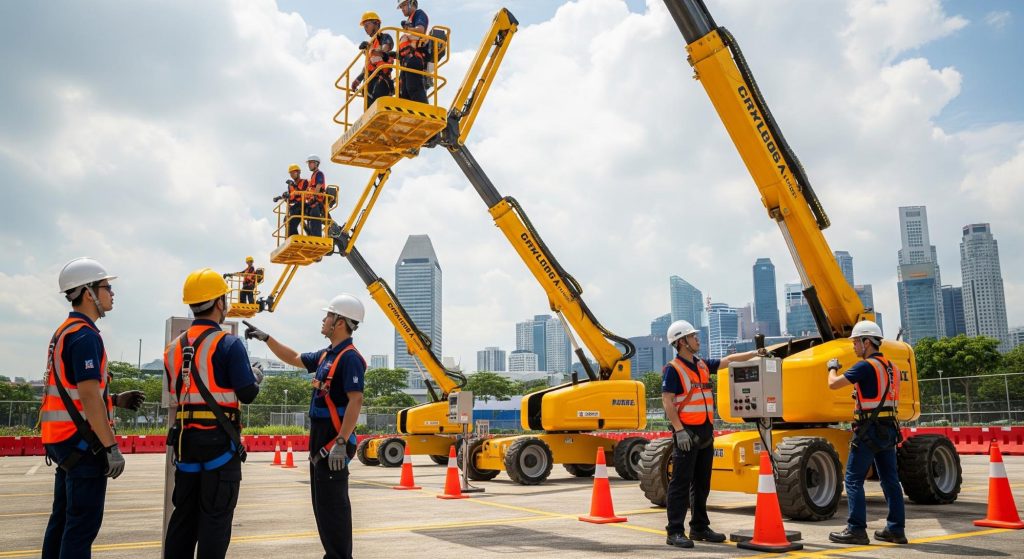
A quality boom lift training programme should balance theoretical knowledge with practical, hands-on experience. When selecting a course, organisations should look for:
- Industry-experienced instructors
- Practical operation sessions using real equipment
- Clear competency assessments
- Alignment with Singapore safety regulations
- Recognised certification for audit and compliance purposes
Pioneer Training Centre offers a structured Operate Boom Lift (OBL) training programme designed to prepare operators for real-world industrial and construction environments.
Frequently Asked Questions (FAQ)
1. Who needs boom lift training?
Any worker who operates, supervises, or works directly with boom lifts or MEWPs should undergo formal training.
2. Is boom lift training mandatory in Singapore?
Employers are required by MOM to ensure workers are trained and competent for their assigned tasks, including MEWP operation.
3. How long does a boom lift operator training course take?
Most courses are completed within 1 to 2 days, combining theory, practical operation, and assessment.
4. What is MEWP Safety Certification?
MEWP Safety Certification confirms that an operator has been trained to safely operate mobile elevated work platforms according to recognised safety standards.
5. Why is certified training better than on-the-job learning?
Certified training provides standardised instruction, formal assessment, and documented proof of competency—reducing accident risks and ensuring compliance.
Invest in Safety with Boom Lift Training
As work-at-height activities continue to increase across industries, proper boom lift training has become a critical safety requirement. Skilled and certified operators play a key role in preventing accidents, protecting lives, and maintaining efficient operations.
Whether you are managing a construction site, overseeing industrial maintenance, or upgrading workforce competencies, enrolling in a recognised Boom Lift Operator Training Course is a practical investment in safety and compliance.
Train with Pioneer Training Centre today and ensure your team operates boom lifts safely, confidently, and responsibly.